Newsletter Subscribe
Enter your email address below and subscribe to our newsletter

 ByJohn A
Data centers depend on reliable servers, networking equipment, storage systems, and electronic control components to support digital operations. Maintaining suitable temperature and humidity levels is essential, but air quality is another important factor in protecting this infrastructure. Airborne dust, corrosive gases, and other molecular contaminants can gradually affect sensitive electronic components and contribute to equipment reliability problems.
Contamination may enter a data center through outdoor air, ventilation systems, building openings, and other pathways. Industrial emissions, vehicle exhaust, wastewater facilities, and nearby pollution sources can introduce gases that are harmful to electronic equipment. If these contaminants remain in circulation, they may contribute to corrosion of circuit boards, connectors, and electrical contacts.
Appropriately selected Data Center Air Filters can help control airborne contamination and support a cleaner operating environment. However, effective protection requires understanding the difference between particulate filtration and gas-phase filtration. Each technology addresses different pollutants, and the right combination depends on the facility’s environmental conditions and equipment protection requirements.
Electronic components contain conductive metals and delicate circuit structures that can be vulnerable to environmental contamination. Dust and fine particles may accumulate on surfaces, obstruct airflow, or contribute to contamination within equipment. Certain gases can also react with susceptible metals, particularly when moisture is present.
Corrosive gases such as hydrogen sulphide, sulphur oxides, chlorine compounds, and nitrogen oxides may contribute to the deterioration of electronic connections. Depending on exposure conditions, corrosion can increase electrical resistance, damage circuit lines, and affect the reliability of printed circuit boards.
These effects may develop gradually, making environmental monitoring important even when equipment appears to operate normally. Controlling airborne contamination helps reduce one potential source of equipment degradation.
Particulate pollutants include dust, fibres, and suspended particles that can be captured by appropriately selected particle filters. Gas-phase contaminants are different because they consist of molecules that may pass through conventional particulate filtration media.
High-efficiency particulate air filters can capture fine particles when correctly specified and installed, but they are not designed to remove every gaseous pollutant. Similarly, precision air conditioning controls temperature and humidity but does not necessarily neutralise corrosive gases.
A comprehensive data center air-quality strategy should therefore evaluate particulate filtration, gas-phase filtration, humidity management, and ventilation as separate but complementary functions.
The filtration requirements of a data center depend partly on its surrounding environment. Potential contamination sources include industrial activity, traffic emissions, drainage systems, construction dust, and chemicals used within the facility.
Facility managers should assess possible sources of contamination, existing ventilation arrangements, and the condition of the equipment room. Corrosion monitoring and suitable air-quality measurements can help establish whether additional gas-phase filtration is necessary.
This assessment provides a more reliable basis for equipment selection than relying only on general assumptions about outdoor air quality.
Particulate filters capture airborne particles as air moves through a filtration medium. The appropriate filter grade depends on particle size, required removal efficiency, airflow, and the system’s pressure-drop limitations.
Pre-filters are often used to capture larger particles before air reaches finer filtration stages. This can help reduce particulate loading on downstream filters and maintain more consistent system performance.
In data centers, particle filtration should be selected according to the ventilation design, cleanliness requirements, and environmental conditions. It remains important to recognise that particle filters alone may not provide adequate protection where corrosive gases are present.
Gas-phase filtration targets gaseous contaminants through adsorption and chemisorption. Adsorption occurs when molecules adhere to a material’s surface, while chemisorption involves chemical interactions between the contaminant and the filter media.
Bry-Air’s DRISORB™ honeycomb chemical filtration technology uses a structured, macroporous matrix with chemical impregnants selected for particular pollutants. This media is designed to capture or neutralise targeted airborne molecular contaminants while supporting airflow through the system.
The correct filter formulation depends on the gases present. A chemical filter intended for one group of pollutants should not automatically be assumed to provide equal performance against every other gas.
A multi-stage filtration unit can combine pre-filtration, chemical filtration, and final particulate filtration. In this arrangement, the initial stage removes larger particles, the chemical media treats targeted gaseous contaminants, and the final stage captures remaining fine particles.
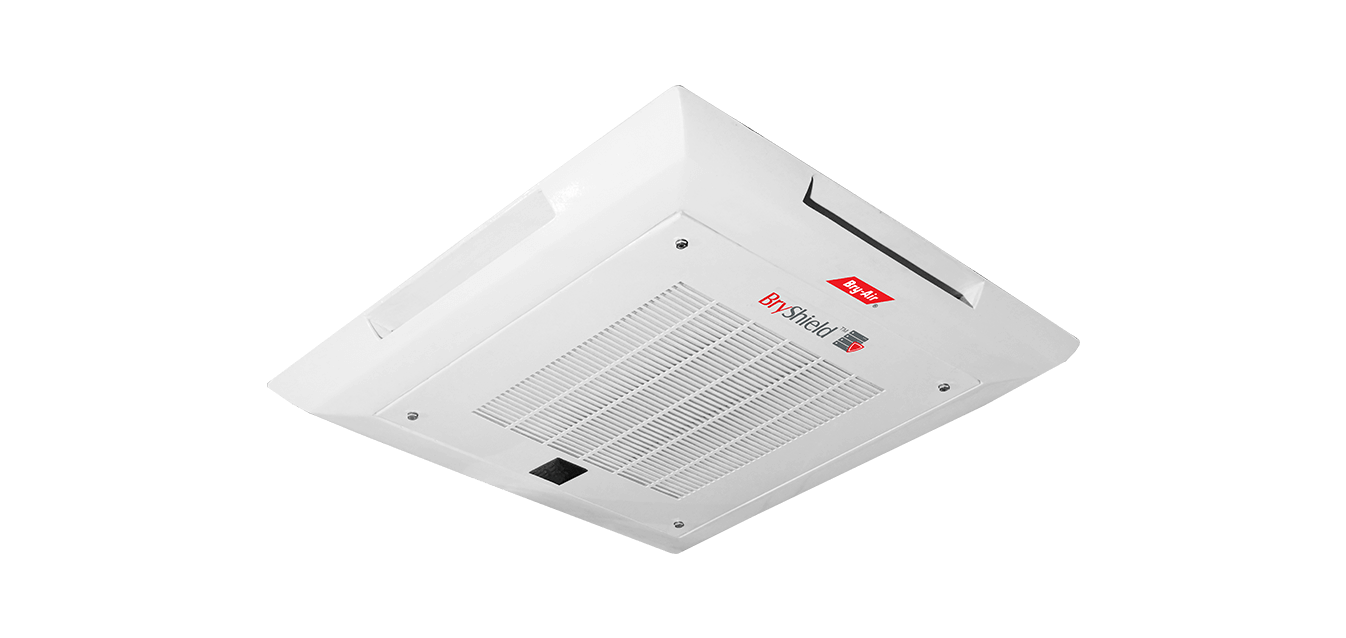
Bry-Air’s BryShield system uses this general approach for smaller server rooms and electronic equipment rooms. Its compact design is intended to help reduce exposure to corrosive gases and particulate contaminants in suitable applications.
For larger data centers, equipment capacity and system configuration must be selected according to the airflow requirement and the contamination load.
A filtration system must circulate an appropriate volume of air to provide the intended treatment. If airflow is insufficient, contaminants may not be controlled effectively throughout the protected space. Excessive pressure drop can also affect airflow and energy consumption.
Selection should consider room dimensions, heat loads, ventilation arrangements, air circulation patterns, contamination sources, and equipment layout. The filter unit must also be compatible with available installation space and electrical requirements.
Bry-Air offers the BryShield system in 100 CFM and 250 CFM models for smaller server rooms and control rooms. Its DataCenter Air Purifier, or DAP Series, provides higher-capacity gas-phase filtration options, with published airflow models ranging from 500 CFM to 2,000 CFM.
These specifications help define available options, but a technical assessment is necessary to determine the appropriate system for a particular facility.
Filter selection should begin with identifying the contaminants that need to be controlled. Some chemical media are designed to address sulphur-containing gases, while others target volatile organic compounds, ammonia, or different pollutants.
The filter formulation, media depth, contact time, airflow, and contaminant concentration all influence performance. A suitable filtration design should match these characteristics to the facility’s actual requirements.
When selecting Data Center Air Filters, facility managers should review the manufacturer’s technical documentation and confirm that the proposed media is suitable for the pollutants identified during the site assessment.
Filtration equipment may operate continuously, so pressure drop and energy consumption should be considered during selection. Media design, fan performance, airflow settings, and filter condition all influence the total operating cost.
Maintenance planning is equally important. Particle filters may require cleaning or replacement, while chemical media must be replaced according to its condition, operating environment, and manufacturer guidance.
Bry-Air states that BryShield’s DRISORB™ chemical filters typically last over a year, although actual service life depends on contamination levels and usage conditions. A scheduled maintenance programme helps prevent declining performance and ensures that filters are replaced when necessary.
Unpleasant odours can indicate the presence of certain gaseous compounds, although odour alone cannot reliably determine whether a contaminant is toxic or corrosive. Some gases can be detected by smell at low concentrations, while others may present risks without a strong odour.
Identifying the source and composition of a gaseous contaminant is therefore important before choosing a treatment method. The objective may involve reducing odours, controlling volatile organic compounds, neutralising corrosive gases, or addressing several air-quality concerns simultaneously.
An Odour Control System designed for the relevant pollutants can use honeycomb chemical filtration to treat selected gaseous contaminants. Bry-Air offers dedicated odour control equipment for applications that require the removal of odorous gases and improvement of indoor air quality.
An odour control unit is not automatically interchangeable with a data center air purifier. Although both may use chemical filtration technology, their capacities, configurations, and intended applications can differ.
Data centers require a solution designed around electronic equipment protection, the expected corrosive gas load, and the required airflow. Other industrial or commercial spaces may need an odour control system tailored to their specific gaseous emissions.
The choice should be based on pollutant identification, technical specifications, installation requirements, and verified suitability for the application.
Regular assessment helps determine whether filtration continues to meet the facility’s requirements. Depending on the contamination risk, monitoring may include corrosion coupons, atmospheric corrosivity monitors, particle measurements, and targeted gas analysis.
These methods provide information about environmental conditions and can help identify changes that require investigation. Monitoring results should be interpreted alongside equipment condition, ventilation performance, and maintenance records.
Air filtration should form part of a broader environmental management programme. Maintaining appropriate humidity, inspecting ventilation systems, controlling pollutant entry, and following filter replacement schedules can improve overall protection.
Facility managers should document maintenance activities and investigate unexpected changes in corrosion indicators or equipment performance. A coordinated approach helps reduce environmental risks without assuming that filtration alone can prevent every equipment failure.
Data center air filtration is an important consideration for protecting sensitive IT infrastructure from airborne particles and corrosive gases. Conventional particulate filters address dust and suspended particles, while specialised gas-phase filtration targets gaseous contaminants that may contribute to electronic corrosion.
The most suitable solution depends on the facility’s contamination profile, airflow requirements, filter media, installation conditions, and maintenance needs. Combining appropriate filtration with environmental monitoring and preventive maintenance can help reduce contamination-related risks and support reliable equipment operation.
Businesses should evaluate their specific requirements before selecting a system and confirm that the chosen filter technology is designed for the pollutants present. To discuss data center air filtration, gas-phase treatment, or application-specific requirements, visit Bry-Air’s Contact Us page.