Newsletter Subscribe
Enter your email address below and subscribe to our newsletter

 ByJohn A
Moisture in compressed air can create problems for equipment, processes, and finished products, particularly when air is used at high pressure. Water vapour can condense as compressed air cools, leading to corrosion, contamination, and unreliable operation of downstream equipment. A refrigeration dryer removes this moisture by cooling compressed air until water vapour condenses and can be separated from the air stream. The FDI series refrigeration dryer India range is designed specifically for high-pressure applications, including PET bottle manufacturing, where compressed air can operate at significantly higher pressures than standard industrial systems.
Compressed air contains moisture from the atmospheric air drawn into the compressor. Compression increases the concentration of water vapour, and subsequent cooling can cause that moisture to condense inside the compressed-air network. If the condensate is not properly removed, it can reach valves, cylinders, instruments, production equipment, and other downstream components.
High-pressure applications require particular attention because the compressed air operates under demanding conditions and may directly support a production process. Drying the air helps control moisture before it reaches sensitive equipment or process points. The required dryer technology depends on pressure, airflow, inlet conditions, pressure dew point, and the level of moisture control required.
Moisture control can help address several compressed-air concerns:
A refrigeration dryer does not simply remove visible liquid water. Its operating principle reduces the temperature of compressed air so that water vapour reaches its condensation point and can then be separated from the air.
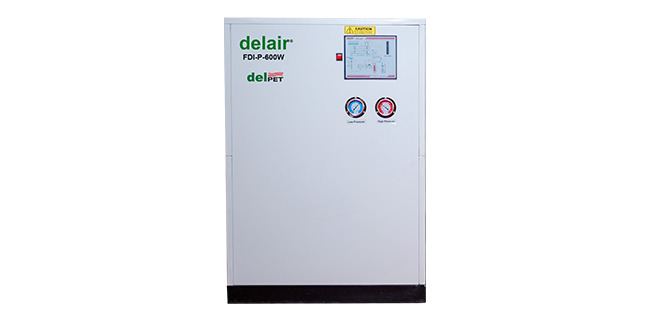
An FDI-P DelPET refrigeration dryer is a high-pressure compressed-air dryer developed for PET bottle manufacturing. Delair lists the FDI-P series with a capacity range from 18.0 m³/hr to 850.0 m³/hr and a pressure range of 18 to 45 kg/cm²(g). The product is available in multiple models and is designed around high-pressure compressed-air drying requirements.
The system uses refrigeration to cool compressed air to near-freezing conditions. As the air temperature falls, moisture condenses and can be separated from the air stream. The dried air is then reheated using incoming compressed air before it continues into the downstream system.
The FDI-P series includes features intended for industrial operation, including a proprietary heat exchanger, a condensate separation arrangement, a refrigeration circuit, and a controller for monitoring operating conditions. Delair states that the system can provide a pressure dew point of approximately +3°C to +4°C and is designed around tropical site parameters.
The drying process starts when wet compressed air enters the dryer. The air passes through heat-exchange stages where its temperature is reduced by the refrigeration circuit. Cooling the compressed air causes water vapour to condense into liquid water, which is then removed by the condensate separation system.
After moisture separation, the cold dry air is reheated by the incoming compressed-air stream. This arrangement helps reduce the temperature difference between the dried air leaving the dryer and the incoming compressed air. Delair describes the FDI-P system as using both air-to-air and refrigerant-to-air heat exchangers as part of its air-drying unit.
The refrigeration circuit contains several major components:
Together, these components provide controlled cooling, condensation, separation, and reheating of the compressed-air stream. The exact configuration and operating conditions vary according to the selected model.
PET bottle manufacturing can require compressed air at substantially higher pressure than many conventional pneumatic applications. During the production process, compressed air quality needs to remain controlled because moisture can interfere with equipment performance and process conditions.
A high-pressure refrigeration dryer must therefore be designed to handle the pressure requirements of the application while still providing effective moisture removal. The FDI-P DelPET series is specifically positioned for PET bottle manufacturing and is rated for high-pressure operation. Its published maximum working pressure is 45 kg/cm²(g), with a standard design operating pressure of 40 kg/cm²(g).
The dryer also needs to manage the heat generated within a high-pressure compressed-air system. Proper heat exchange is essential because the refrigeration circuit must remove sufficient thermal energy to bring the compressed air to the required drying condition.
The FDI-P DelPET series is designed for high-pressure compressed-air applications. Delair publishes an operating pressure range of 18 to 45 kg/cm²(g), with standard design parameters based on 40 kg/cm²(g) operating pressure and 45 kg/cm²(g) maximum working pressure.
Pressure should always be considered together with airflow capacity and inlet conditions when selecting a dryer. A unit that is suitable for one pressure and flow combination may not provide the same performance under another set of operating conditions. Engineers should therefore evaluate the actual compressor discharge conditions, required flow rate, inlet temperature, ambient conditions, and desired pressure dew point.
Heat exchange is central to the operation of a refrigeration dryer. Incoming wet compressed air can exchange energy with the outgoing dry air, helping pre-cool the incoming stream before it reaches the colder section of the refrigeration circuit. This reduces the cooling duty required to reach the target drying temperature.
The refrigeration circuit then provides additional cooling through the refrigerant-to-air heat exchanger. Once moisture condenses, the condensate separator removes it from the compressed-air stream. The dried air can then be reheated through the air-to-air heat exchanger before leaving the dryer.
This sequence helps the dryer manage the temperature changes required for moisture removal without simply sending very cold air into the downstream compressed-air network.
Pressure dew point indicates the temperature at which water vapour in compressed air begins to condense under the system’s operating pressure. It is a useful specification when evaluating whether a dryer can provide the required moisture control for a particular application.
Delair states that the FDI-P series provides a pressure dew point from approximately +3°C to +4°C under its specified conditions. The appropriate pressure dew point should always be determined from the application because different processes can have different moisture-control requirements.
A refrigeration dryer is generally suited to applications where this level of moisture control is adequate. Applications requiring substantially lower dew points may call for adsorption-based drying technologies instead.
Refrigeration and desiccant dryers use different mechanisms to control moisture in compressed air. Refrigeration dryers cool the compressed air so that moisture condenses and can be separated. Desiccant dryers use an adsorbent material to capture water vapour directly from the compressed-air stream.
The selection depends on the required pressure dew point, operating conditions, energy considerations, airflow, and process requirements. A refrigeration dryer can be suitable where moderate moisture control is required, while adsorption technology is generally considered where a much lower dew point is necessary.
Other drying technologies can also be considered for specific industrial requirements. For example, a compressed air dryer with HOC technology uses heat generated during compression to regenerate the desiccant. Delair’s CAHC/HD system uses hot compressed air for regeneration before cooling the air and directing it through the regenerated adsorber for drying.
Selecting a high-pressure dryer requires more than matching the compressor’s nominal capacity. The dryer needs to be evaluated under the actual operating conditions expected at the installation site. Pressure, airflow, temperature, humidity, pressure dew point, cooling method, and available utilities can all influence the final selection.
Key considerations include:
Delair’s published standard design parameters for the FDI-P series include a 45°C air inlet temperature and 45°C ambient temperature. Water-cooled versions are also listed with specified cooling-water pressure and temperature conditions.
Yes, depending on the moisture specification and application. Refrigeration dryers and adsorption dryers solve moisture problems through different processes, so the correct choice depends on the required level of drying.
For applications requiring adsorption drying, a blower regenerated compressed air dryer can regenerate its desiccant using heated ambient air supplied by a blower. Delair’s CABL series uses a blower and heater during regeneration, after which the desiccant is prepared for another drying cycle.
This type of system can be considered when the application requires adsorption-based drying rather than condensation-based moisture removal. The choice should be based on the required dew point, operating cycle, available energy sources, airflow, and overall compressed-air system design.
A refrigeration dryer needs regular maintenance to continue operating at its designed performance level. Filters, condensate drainage components, heat-transfer surfaces, refrigeration components, and control systems should be inspected according to the manufacturer’s maintenance requirements.
Poor maintenance can affect heat transfer and condensate removal, potentially increasing the moisture level downstream. Blocked or dirty heat-transfer surfaces can also reduce the effectiveness of the cooling process and increase the refrigeration load.
A practical maintenance program should include:
Monitoring pressure dew point can also provide useful information about dryer performance. Changes in dew point, pressure drop, or operating temperature can indicate that inspection or servicing is required.
A high-pressure refrigeration dryer removes moisture from compressed air through controlled cooling, condensation, separation, and reheating. For applications such as PET bottle manufacturing, the drying system must be designed to operate reliably at elevated pressures while maintaining the required pressure dew point. The FDI-P DelPET series is specifically designed for this type of high-pressure compressed-air drying and is available across multiple capacity models.
The right dryer selection depends on the complete compressed-air system, including pressure, flow, inlet conditions, moisture requirements, cooling method, and operating environment. Where refrigeration drying is not the right fit, alternative technologies such as heat-of-compression or blower-regenerated adsorption dryers can be evaluated based on the required dew point and process conditions. For assistance with selecting a suitable compressed-air drying system, contact Delair India Pvt Ltd.
An FDI series refrigeration dryer is a compressed-air drying system that removes moisture by cooling compressed air until water vapour condenses. The FDI-P DelPET series is designed specifically for high-pressure applications, including PET bottle manufacturing.
The FDI-P DelPET series is published with an operating pressure range of 18 to 45 kg/cm²(g). Delair lists 40 kg/cm²(g) as the standard design operating pressure and 45 kg/cm²(g) as the maximum working pressure.
The FDI-P series is specified with a pressure dew point of approximately +3°C to +4°C under the stated operating conditions. Actual performance depends on the application and operating parameters.
A high-pressure refrigeration dryer can be suitable for PET manufacturing where compressed air requires controlled moisture levels. The FDI-P DelPET series is specifically designed for the PET bottle manufacturing process.
Consider the required airflow, operating pressure, inlet temperature, ambient conditions, pressure dew point, cooling method, pressure drop, and installation requirements. The dryer should be selected based on actual operating conditions rather than compressor capacity alone.