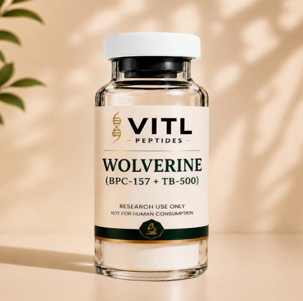

The Wolverine peptide combination is a name commonly used for products containing BPC-157 and TB-500 or a related thymosin-derived compound. It has attracted attention in discussions about tissue repair, inflammation, and physical recovery. However, interest in these compounds should not be confused with established clinical evidence. The biological effects, safety profile, and effectiveness of the combined formulation require careful scientific evaluation.
When reviewing a Wolverine (BPC-157 + TB-500) research peptide, it is important to verify the exact ingredients, product specifications, and available analytical documentation. The name alone does not confirm the molecular identity of each component or demonstrate that the combination produces a particular outcome. Understanding the research background and limitations helps distinguish experimental findings from unsupported claims.
What Is the Wolverine Research Peptide Combination?
The Wolverine peptide combination generally refers to a product marketed as containing BPC-157 and TB-500. The name is not a standardized scientific designation, so the precise composition may depend on the product. Researchers should examine the product label and supporting documentation rather than assume that all products using this name contain identical ingredients.
Understanding the two components separately is important because they have different research backgrounds and cannot automatically be treated as interchangeable substances.
Understanding the Common Meaning of the Wolverine Name
The term Wolverine is a marketing name used for combinations associated with research into tissue-related biological processes. It is not the formal name of a single, universally defined molecule. Products using this label may describe a combination of BPC-157 and TB-500, but the exact composition must be confirmed for each formulation.
A product name does not establish the identity, concentration, purity, or biological activity of its contents. Reliable evaluation requires clear specifications, batch identification, and analytical evidence supporting the stated ingredients.
An Overview of BPC-157
BPC-157 is a synthetic peptide consisting of 15 amino acids. It has been investigated primarily in preclinical research involving tissue responses, gastrointestinal biology, inflammatory processes, and other biological pathways.
Some experimental findings have suggested biological activity that warrants further investigation. However, most of the available research is preclinical, and high-quality human evidence remains insufficient to establish BPC-157 as a proven treatment for injuries or other medical conditions.
Researchers should distinguish the potential mechanisms being investigated from demonstrated clinical benefits. Findings from laboratory or animal models cannot independently establish effectiveness or long-term safety in humans.
An Overview of TB-500 and Related Thymosin Research
TB-500 is a name used in research-product marketing that is associated with thymosin beta-4-related research. Thymosin beta-4 is a naturally occurring peptide involved in biological processes, including actin regulation and cellular movement. These processes have been studied in connection with tissue responses and repair.
However, TB-500 should not automatically be considered identical to full-length thymosin beta-4. The exact molecular identity and sequence of a product marketed under this name should be verified through appropriate documentation. Research involving thymosin beta-4 also cannot automatically be treated as direct evidence for every product described as TB-500.
Why Exact Product Composition Needs Verification
The identity of each ingredient is essential to interpreting research results. Product descriptions should specify the compounds present, their relevant molecular characteristics, and any stated quantities or ratios.
If the composition is unclear, researchers cannot reliably determine whether published findings apply to the material being evaluated. Product documentation should therefore be checked before drawing conclusions about experimental suitability, biological activity, or product quality.
How Do BPC-157 and TB-500 Differ?
Although BPC-157 and TB-500 are frequently discussed together, they have different molecular identities and research histories. Their proposed biological activities should be evaluated separately before considering claims about a combined formulation.
Understanding these differences helps prevent the assumption that two compounds will necessarily produce the same effects or work together in a predictable way.
Differences in Molecular Identity and Research Background
BPC-157 is a synthetic 15-amino-acid peptide associated with a fragment derived from a protein found in gastric juice. TB-500 is a research-product designation associated with thymosin beta-4-related compounds. These differences matter because amino acid sequence and molecular structure influence a substance’s properties and potential interactions with biological systems.
Research on one compound cannot automatically validate claims about the other. Identity should be established using product-specific information and suitable analytical methods rather than relying on broad category descriptions.
Separate Research Questions Associated With Each Compound
BPC-157 research has explored biological processes associated with tissue responses, inflammation, and gastrointestinal systems. Thymosin beta-4-related research has examined cellular movement, actin regulation, and processes relevant to tissue biology.
These research areas may overlap conceptually, but they involve distinct scientific questions. Each compound requires appropriate experimental evidence to establish its activity, and claims about specific outcomes must be evaluated according to the methods and findings of the relevant studies.
Why Similar Marketing Claims Do Not Mean Identical Biological Activity
Products may be promoted using similar language about recovery or tissue repair, but shared marketing descriptions do not establish identical biological effects. A proposed mechanism must be supported by direct evidence showing that the compound produces the reported effect under defined conditions.
Researchers should examine the actual experimental outcomes rather than assume that similar promotional claims reflect equivalent molecular activity. The strength of the evidence depends on study quality, reproducibility, and relevance to the question being investigated.
What Does Research Say About the Combined Formulation?
The evidence for a combination must be evaluated separately from the evidence for each individual ingredient. Even if two substances have been studied independently, their combined effects, interactions, and safety cannot be predicted reliably without appropriate testing.
Evidence for BPC-157 as an Individual Compound
BPC-157 has been examined in laboratory and animal studies involving several biological processes. Some findings have suggested possible effects on pathways associated with tissue responses and inflammation, but these results do not establish clinical benefits in humans.
Limitations include differences between experimental models and human physiology, variation in research methods, and a lack of sufficiently robust clinical evidence. Claims about injury recovery or other medical outcomes should therefore remain proportionate to the available evidence.
Evidence for TB-500 and Related Compounds
Research on thymosin beta-4 has investigated its biological functions and potential relevance to cellular movement and tissue-related processes. However, results involving thymosin beta-4 cannot automatically be attributed to a product marketed as TB-500 unless the molecular identity and relevant research evidence support that connection.
Researchers should examine the exact substance studied, the experimental model, and the outcome measured. Evidence involving a related molecule may help inform further research, but it does not establish the effects of every related compound or commercial formulation.
Why Evidence for Individual Components Cannot Establish Combination Efficacy
Combining two compounds introduces additional questions about interactions, stability, biological activity, and potential adverse effects. A combination could behave differently from either ingredient studied independently, and the direction or magnitude of any difference cannot be assumed.
Evidence supporting one component does not establish that a blend is more effective, safer, or more reliable. To evaluate a combination properly, researchers need studies that examine the exact formulation and compare its outcomes under appropriate experimental conditions.
Gaps in Controlled Human Research
There is insufficient high-quality controlled human evidence to establish the safety and effectiveness of the Wolverine combination as a medical treatment. Without suitable clinical studies, questions about clinical outcomes, potential adverse effects, interactions, and long-term risks remain unresolved.
Researchers should look for studies with clear methods, appropriate comparison groups, adequate sample sizes, and transparent reporting. Until stronger evidence becomes available, claims about predictable recovery or treatment benefits should be treated cautiously.
What Quality Considerations Apply to Multi-Compound Products?
Multi-compound products require careful quality assessment because each ingredient introduces separate identity and composition questions. Reliable documentation should make it possible to assess the stated components and determine whether the testing adequately supports the product specifications.
Confirming the Identity of Each Component
The product documentation should identify both BPC-157 and the stated TB-500-related compound. Where applicable, the relevant amino acid sequences, expected molecular masses, and other identifying characteristics should be provided.
A generic blend name is not enough to verify molecular identity. Suitable analytical testing should support the claimed composition, and the results should correspond to the actual batch being evaluated.
Reviewing Batch-Specific Testing and Purity Reports
A certificate of analysis, or CoA, summarizes selected tests and results for a product or batch. High-performance liquid chromatography (HPLC) can help assess chromatographic purity, while mass spectrometry can support molecular identity assessment.
Researchers should review the methods used, batch identification, reported results, and limitations of the documentation. A report that does not identify the tested sample or explain its methods may provide limited assurance about the material being evaluated.
Understanding Component Ratios and Product Specifications
The quantities or proportions of the individual components are important characteristics of a blend. If the product documentation does not clearly specify the formulation, it may be difficult to interpret research results or compare the product with a published study.
Researchers should verify that the stated composition is supported by relevant records. A product’s overall weight or total purity figure does not necessarily establish the amount or identity of each component.
Why Blend Documentation Requires More Than a Single Purity Figure
A single purity percentage may not explain the identity, quantity, or distribution of the individual ingredients in a multi-compound product. Analytical results must be interpreted in the context of the method used and the specific question the test can answer.
Quality evaluation may require complementary evidence addressing identity, purity, composition, and stability. Even strong analytical results do not demonstrate that a blend is clinically effective or suitable for human use.
What Are the Safety and Regulatory Considerations?
The safety profile of a research compound depends on the substance itself, its formulation, the quality of the material, and the context in which it is studied. For the Wolverine combination, uncertainty remains because evidence for the exact combined formulation is limited.
Uncertainty Surrounding Human Safety and Effectiveness
Preclinical observations cannot establish the complete safety profile of a compound in humans. Potential risks may vary according to exposure, individual characteristics, product quality, and interactions between ingredients.
The absence of extensive clinical data should not be interpreted as proof of safety. Researchers should clearly distinguish known findings from unanswered questions and avoid treating experimental compounds as established medical treatments.
Potential Impurity and Immunogenicity Concerns
Synthetic peptide products may contain impurities arising from manufacturing, purification, or degradation. Such substances may affect experimental results or introduce additional safety concerns. In a blend, each component requires appropriate quality controls.
Immunogenicity, or the potential to trigger an immune response, is another consideration. Its likelihood and significance depend on molecular characteristics, impurities, exposure, and biological context. Available evidence may not be sufficient to characterize these risks fully for a combined formulation.
Research-Only Labeling and Applicable Restrictions
A research-only designation indicates that a product should not be presumed suitable for medical treatment. Online availability does not establish regulatory approval, clinical effectiveness, or authorization for human administration.
Researchers should check current guidance from the relevant regulatory authority and follow applicable institutional requirements. Product labeling, handling instructions, and restrictions should be reviewed before determining whether a material is appropriate for a particular research setting.
How Can Researchers Evaluate Claims About Wolverine Peptide?
Claims about a peptide combination should be assessed using evidence that directly addresses the formulation and the outcome being claimed. Promotional descriptions may simplify complex scientific findings, so independent evaluation is important.
Separating Anecdotal Reports From Controlled Evidence
Anecdotal reports do not provide the same level of evidence as well-designed controlled studies. Individual accounts may lack comparison groups, standardized measurements, and information about other factors that could influence an outcome.
Reliable evaluation requires research with transparent methods and reproducible results. Claims about safety or effectiveness should not depend solely on testimonials, online discussions, or promotional statements.
Checking Whether a Study Examined the Exact Combination
Researchers should determine whether a published study investigated BPC-157 alone, a thymosin beta-4-related compound, or the precise combination being evaluated. The molecular identity, formulation, and experimental conditions should match the claim as closely as possible.
Evidence involving one ingredient or a related molecule cannot establish the effects of a different blend. The closer the research matches the actual formulation and intended research question, the more directly relevant its findings may be.
Evaluating Claims About Tissue Repair and Physical Recovery
Claims involving tissue repair, injury recovery, or physical performance require evidence that directly measures the relevant outcomes. Changes in a laboratory marker or observations in an animal model do not automatically demonstrate a meaningful clinical benefit.
Researchers should examine study design, outcome definitions, statistical results, limitations, and independent replication. Conclusions should remain within the boundaries of the evidence rather than extend beyond what the studies establish.
For general product information and research-related resources, visit Vitl Peptides. Product information can help clarify stated specifications, but scientific claims should be evaluated against independent research and appropriate quality documentation.
Frequently Asked Questions
What Does the Name Wolverine Peptide Refer To?
Wolverine peptide is a common marketing name for a combination generally described as containing BPC-157 and TB-500 or a related thymosin-derived compound. The exact ingredients and proportions should be verified from product-specific documentation.
Are BPC-157 and TB-500 the Same Compound?
No. BPC-157 is a synthetic 15-amino-acid peptide, while TB-500 is a product name associated with thymosin beta-4-related research. Their molecular identities and research backgrounds differ, and they should not be treated as interchangeable.
Does Research Establish the Benefits of Combining These Compounds?
No. Available evidence does not establish the safety or effectiveness of the Wolverine combination as a medical treatment. Findings involving individual ingredients cannot prove that combining them produces additional benefits or predictable outcomes.
What Documentation Should Be Available for a Peptide Blend?
Relevant documentation should identify the components, provide batch-specific specifications, and include appropriate analytical results. HPLC and mass spectrometry may help assess purity and identity, while clear manufacturing and storage information supports traceability and quality evaluation.
Is the Wolverine Combination an Approved Medicine?
The Wolverine combination should not be assumed to be an approved medicine. Current regulatory status should be checked through the appropriate official authority. Online availability and research-related descriptions do not establish authorization for human medical use.
Conclusion
The Wolverine peptide combination is discussed in connection with research into tissue-related biological processes, but scientific interest should not be confused with established clinical effectiveness. BPC-157 and TB-500 have different molecular identities and research backgrounds, and findings involving individual compounds do not establish the effects of the combined formulation.
Responsible evaluation requires verification of each component, batch-specific analytical testing, clear formulation details, manufacturing traceability, and appropriate storage documentation. Researchers should also consider the limitations of preclinical evidence, unresolved human safety questions, and relevant regulatory restrictions. Ultimately, conclusions about the Wolverine combination should be based on reliable evidence that directly addresses the exact formulation, rather than assumptions or promotional claims.
For more information about the company and its background, visit the About us page.