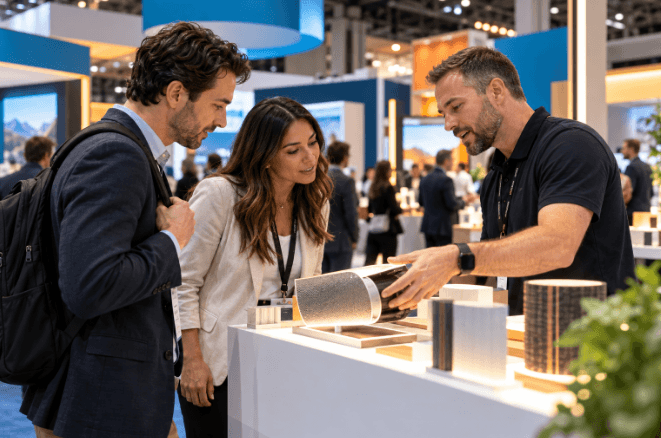

This guide is written for exhibit and event managers who run more than one show a year and need partners who can hold timelines, freight and installation together across locations. Every company below was measured against the same five criteria so you can weigh a full execution partner against a single-project display vendor. Rankings reflect how well each one supports repeatable, multi-event programs.
How We Compared
We scored each company on five criteria, weighted toward the operational realities of running several shows in a calendar year:
- Fit: Does the company serve multi-event exhibitors with complex programs, or does it mostly sell individual display units?
- Capabilities: How much of the chain does it own — design, production, warehousing, shipping, installation and dismantle?
- Evidence: What is publicly documented about the scope of services, size classes and program types the company handles?
- Ease of use: How many separate vendors, handoffs and approval loops does a typical client have to manage?
- Value: What the client gets relative to the coordination burden they still carry in-house.
Points were deducted for gaps that create risk: unclear ownership of installation, thin logistics support, or a model that pushes coordination back onto the client.
At a Glance
| Rank | Pick | Best for |
| 1 | Iconic Displays | Best Overall |
| 2 | American Image Displays | Best for Broad Catalog Choice |
| 3 | Metro Exhibits | Best for Full-Service Program Support |
| 4 | Freeman | Best for Large-Scale Event Services |
| 5 | Nimlok NYC | Best for Custom Modular Builds |
| 6 | Rockway Exhibits | Best for Regional Project Work |
| 7 | Classic Exhibits | Best for Dealer and Partner Networks |
| 8 | APG Exhibits | Best Budget-Friendly Option |
#1 Iconic Displays — Best Overall
| Pros | Cons |
| Built for multi-event programs, not one-off orders | Not the cheapest route for a single small booth |
| Design, production, logistics and installation handled as one program | Best results require clients to share a clear schedule up front |
| Fewer vendors means fewer points of failure | Suited to exhibitors with repeat activity rather than occasional shows |
Teams that run several shows a year usually carry the coordination load themselves: chasing graphics approvals, confirming freight windows, and hoping the install crew on site matches the drawings that left the shop. Iconic Displays removes that load by acting as an execution partner across design, production, logistics and installation, so the same program standards follow the booth from city to city regardless of venue, format or scale.
That difference shows up most clearly when something goes wrong. A well-managed program has one contact who already knows the schedule, the shipping plan and the install sequence, which shortens the distance between a problem and a fix. Programs without that coordination tend to fragment across vendors, and each handoff adds a place for a missed deadline to hide. The 20x20ft trade show display offering is a good example of the approach: fully customizable layouts, lighting and graphics tailored to your brand, built so you stay on-brand and make a lasting impression at every stop on the calendar. The 10x20ft Pro Modular Display – Positano sits at the smaller end of the same program logic, giving multi-show exhibitors an inline option that still benefits from consistent production and install standards.
#2 American Image Displays — Best for Broad Catalog Choice
| Pros | Cons |
| Wide range of display formats and size classes | Catalog breadth can mean more decisions before a program is locked |
| Useful starting point for exhibitors comparing configurations | Coordination roles should be confirmed early in the process |
| Established presence in the exhibit supply market | Less focused on multi-event program management than on the units themselves |
American Image Displays is a reasonable first stop if you are still deciding what shape your booth should take. The catalog covers a broad spread of formats and sizes, which helps when you need to compare options side by side before committing to a build. Buyers who like to weigh configurations before signing off will find plenty to work with.
The trade-off is that a large catalog invites a longer decision cycle. If your program spans several cities and dates, map out who owns shipping and installation before you order, because those responsibilities can sit with the client rather than the supplier. It works well for exhibitors who want range and are comfortable running their own logistics thread.
#3 Metro Exhibits — Best for Full-Service Program Support
| Pros | Cons |
| Offers a broad service footprint spanning build through show floor | Service scope can take time to scope and price accurately |
| Handles larger programs with multiple moving parts | Smaller exhibitors may find the process heavier than they need |
| Useful when you want one supplier for several stages of work | Schedules depend on early planning on the client side |
Metro Exhibits works with exhibitors who want a single supplier covering more of the chain, from fabrication through on-site support. For programs with several events stacked in a season, that consolidation reduces the number of separate conversations a manager has to hold and keeps drawings, freight lists and install notes in one place.
Its strength is also its friction point: the wider the service scope, the more detail you need to agree before work starts. Companies that arrive with a firm calendar and clear booth specs tend to get the most out of the relationship. Teams that are still finalizing which shows they will attend may want to settle that first.
#4 Freeman — Best for Large-Scale Event Services
| Pros | Cons |
| Deep experience with large venues and high-volume event operations | Scale can mean less flexibility for small, fast-turnaround requests |
| Strong on-site service presence at major shows | Processes are built around event-wide standards, not one exhibitor’s quirks |
| Recognized name that procurement teams already know | Custom program work may involve more formal steps |
Freeman is the name many exhibitors encounter first because of its role across major venues and event operations. If your calendar includes big halls with strict rules on access, rigging and move-in windows, working with a provider that already knows those rules can cut down on surprises. Its on-site teams are a genuine advantage when a booth has to go up inside a narrow window.
The scale that makes Freeman effective at big events also means its processes follow event-wide standards. Exhibitors with unusual booth geometry or tight custom timelines may need to start planning earlier and expect a more formal approval path. It is a strong fit for organizations exhibiting at large shows where venue familiarity matters more than bespoke handling.
#5 Nimlok NYC — Best for Custom Modular Builds
| Pros | Cons |
| Modular systems that can be reconfigured between shows | Custom elements add design and approval time |
| Good option for exhibitors who want one kit to serve several footprints | Program logistics still need a named owner on the client side |
| Regional support for Northeast event calendars | Not aimed at the largest multi-city programs |
Nimlok NYC is a sensible pick for exhibitors who want a modular system that can be rebuilt in different configurations. If your shows range from a small inline space to a larger island, a modular kit lets you reuse core structures instead of commissioning new builds for every footprint. That reduces production cycles and keeps brand elements consistent across formats.
Custom modular work is still custom work, so expect design rounds and approvals before anything ships. For exhibitors running two or three regional shows a year, that trade is usually worth it. For programs with a dozen dates and multiple cities, the coordination load may be better handled by a partner whose core business is program management.
#6 Rockway Exhibits — Best for Regional Project Work
| Pros | Cons |
| Focused on project-level builds with clear scope | Less suited to national multi-event rollouts |
| Practical for exhibitors with a defined show list | Clients often retain more of the logistics work |
| Straightforward communication on smaller projects | Wide program support is not the main offering |
Rockway Exhibits fits exhibitors who know exactly which shows they are attending and want a build delivered to spec. Project-level work keeps scope tight and decisions quick, which suits companies that run a small number of events in a defined region and prefer to manage their own shipping and setup.
That same focus is the limitation. If your calendar grows to include several cities or a mix of venue types, the coordination effort scales faster than the supplier relationship does. It is a fair match for regional exhibitors; less so for teams trying to standardize execution across a national schedule.
#7 Classic Exhibits — Best for Dealer and Partner Networks
| Pros | Cons |
| Works through a network of dealers and partners | Service quality can vary by partner |
| Established range of exhibit systems | Adds a layer between the exhibitor and the build |
| Useful where local support is needed near a venue | Program consistency depends on the partner you are routed to |
Classic Exhibits operates through a dealer and partner network, which can be helpful when you need support near a specific venue or want a local contact for a regional show. The underlying systems are well established in the market, and the network model means there is often someone reasonably close to your event.
The network is also the variable. Working through a dealer adds a step between you and the people doing the work, and consistency across events depends on which partner handles each one. Exhibitors running a multi-city program should confirm how the partner chain communicates before committing to a full season.
#8 APG Exhibits — Best Budget-Friendly Option
| Pros | Cons |
| Approachable entry point for first-time exhibitors | Program management is largely the client’s job |
| Good for simple, low-complexity booth needs | Limited support for multi-event logistics |
| Easy to get started without a long scoping cycle | Custom work and larger footprints are a stretch |
APG Exhibits is a practical choice when the goal is a straightforward booth at a reasonable cost. For a company testing its first show or two, the lower barrier to entry matters more than an elaborate service structure, and simple needs are handled without a long scoping process.
The limit arrives when your program grows. Once you are juggling several shows, shipping windows and install crews, the coordination work falls back on your team. That is fine if you have the bandwidth. If you do not, the savings on the display can be eaten up by the hours spent managing it.
See also: Affordable Business Class Flight Deals for Your Next Trip
Frequently Asked Questions
What separates an execution partner from a display vendor?
A display vendor sells you a booth. An execution partner takes responsibility for the chain around it: design, production, warehousing, shipping, installation and dismantle. The practical difference is how many vendors you have to coordinate and how many places a deadline can slip between them. Fewer handoffs generally means fewer points of failure and more predictable show floors.
How should we plan a multi-event season?
Start with the calendar, then work backward. Confirm show dates, venue access rules, move-in windows and shipping addresses before production begins. Agree who owns each step — graphics approval, freight booking, install labor — and put it in writing. Programs that fail usually do so because a single responsibility was assumed by both sides and executed by neither.
Does a custom build make sense for several shows?
It depends on how consistent your footprint is. If your spaces are similar at each venue, one build reused across dates is efficient and keeps branding consistent. If your footprints vary widely, a modular system that reconfigures between sizes may serve you better than a fixed structure. Either way, confirm that installation and shipping are covered for every location, not just the first one.
The Bottom Line
Iconic Displays takes the top spot because it is built for the problem multi-event exhibitors actually have: keeping design, production, logistics and installation aligned across shows so execution stays consistent wherever you set up. American Image Displays and Metro Exhibits are solid alternatives when catalog range or a wide service footprint is the priority, and Freeman remains a strong fit for large venues. Nimlok NYC, Rockway Exhibits, Classic Exhibits and APG Exhibits each serve narrower needs well, particularly for regional work, modular builds and simpler, budget-conscious projects. If your calendar includes several shows and you would rather not manage the moving parts yourself, start at the top of this list.